 Mission
 The F-15 Eagle is an all-weather, extremely maneuverable, tactical fighter designed to permit the Air Force to gain and maintain air supremacy over the battlefield.
Features
The Eagle's air superiority is achieved through a mixture of unprecedented maneuverability and acceleration, range, weapons and avionics. It can penetrate enemy defense and outperform and outfight any current enemy aircraft. The F-15 has electronic systems and weaponry to detect, acquire, track and attack enemy aircraft while operating in friendly or enemy-controlled airspace. The weapons and flight control systems are designed so one person can safely and effectively perform air-to-air combat.
The F-15's superior maneuverability and acceleration are achieved through high engine thrust-to-weight ratio and low wing loading. Low wing-loading (the ratio of aircraft weight to its wing area) is a vital factor in maneuverability and, combined with the high thrust-to-weight ratio, enables the aircraft to turn tightly without losing airspeed.
A multimission avionics system sets the F-15 apart from other fighter aircraft. It includes a head-up display, advanced radar, inertial navigation system, flight instruments, ultrahigh frequency communications, tactical navigation system and instrument landing system. It also has an internally mounted, tactical electronic-warfare system, "identification friend or foe" system, electronic countermeasures set and a central digital computer.
The pilot's head-up display projects on the windscreen all essential flight information gathered by the integrated avionics system. This display, visible in any light condition, provides information necessary to track and destroy an enemy aircraft without having to look down at cockpit instruments.
The F-15's versatile pulse-Doppler radar system can look up at high-flying targets and down at low-flying targets without being confused by ground clutter. It can detect and track aircraft and small high-speed targets at distances beyond visual range down to close range, and at altitudes down to treetop level. The radar feeds target information into the central computer for effective weapons delivery. For close-in dogfights, the radar automatically acquires enemy aircraft, and this information is projected on the head-up display. The F-15's electronic warfare system provides both threat warning and automatic countermeasures against selected threats.
A variety of air-to-air weaponry can be carried by the F-15. An automated weapon system enables the pilot to perform aerial combat safely and effectively, using the head-up display and the avionics and weapons controls located on the engine throttles or control stick. When the pilot changes from one weapon system to another, visual guidance for the required weapon automatically appears on the head-up display.
The Eagle can be armed with combinations of different air-to-air weapons: AIM-120 advanced medium range air-to-air missiles on its lower fuselage corners, AIM-9L/M Sidewinder or AIM-120 missiles on two pylons under the wings, and an internal 20mm Gatling gun in the right wing root.
The F-15E is a two-seat, dual-role, totally integrated fighter for all-weather, air-to-air and deep interdiction missions. The rear cockpit is upgraded to include four multi-purpose CRT displays for aircraft systems and weapons management. The digital, triple-redundant Lear Siegler flight control system permits coupled automatic terrain following, enhanced by a ring-laser gyro inertial navigation system.
For low-altitude, high-speed penetration and precision attack on tactical targets at night or in adverse weather, the F-15E carries a high-resolution APG-70 radar and low-altitude navigation and targeting infrared for night pods
Background
The first F-15A flight was made in July 1972, and the first flight of the two-seat F-15B (formerly TF-15A) trainer was made in July 1973. The first Eagle (F-15B) was delivered in November 1974. In January 1976, the first Eagle destined for a combat squadron was delivered.
The single-seat F-15C and two-seat F-15D models entered the Air Force inventory beginning in 1979. These new models have Production Eagle Package (PEP 2000) improvements, including 2,000 pounds (900 kilograms) of additional internal fuel, provision for carrying exterior conformal fuel tanks and increased maximum takeoff weight of up to 68,000 pounds (30,600 kilograms).
The F-15 Multistage Improvement Program was initiated in February 1983, with the first production MSIP F-15C produced in 1985. Improvements included an upgraded central computer; a Programmable Armament Control Set, allowing for advanced versions of the AIM-7, AIM-9, and AIM-120A missiles; and an expanded Tactical Electronic Warfare System that provides improvements to the ALR-56C radar warning receiver and ALQ-135 countermeasure set. The final 43 included a Hughes APG-70 radar.
F-15C, D and E models were deployed to the Persian Gulf in 1991 in support of Operation Desert Storm where they proved their superior combat capability. F-15C fighters accounted for 34 of the 37 Air Force air-to-air victories. F-15E's were operated mainly at night, hunting SCUD missile launchers and artillery sites using the LANTIRN system.
They have since been deployed for air expeditionary force deployments and operations Southern Watch (no-fly zone in Southern Iraq), Provide Comfort in Turkey, Allied Force in Bosnia, Enduring Freedom in Afghanistan and Iraqi Freedom in Iraq.
General Characteristics
Primary function: Tactical fighter
Contractor: McDonnell Douglas Corp.
Power plant: Two Pratt & Whitney F100-PW-100, 220 or 229 turbofan engines with afterburners
Thrust: (C/D models) 23,450 pounds each engine
Wingspan: 42.8 feet (13 meters)
Length: 63.8 feet (19.44 meters)
Height: 18.5 feet (5.6 meters)
Weight: 31,700 pounds
Maximum takeoff weight: (C/D models) 68,000 pounds (30,844 kilograms)
Fuel Capacity: 36,200 pounds (three external plus conformal fuel tanks)
Payload: depends on mission
Speed: 1,875 mph (Mach 2 class)
Ceiling: 65,000 feet (19,812 meters)
Range: 3,450 miles (3,000 nautical miles) ferry range with conformal fuel tanks and three external fuel tanks
Crew: F-15A/C: one. F-15B/D/E: two
Armament: One internally mounted M-61A1 20mm 20-mm, six-barrel cannon with 940 rounds of ammunition; four AIM-9 Sidewinder and four AIM-120 AMRAAMs or eight AIM-120 AMRAAMs, carried externally.
Unit Cost: A/B models - $27.9 million (fiscal 98 constant dollars);C/D models - $29.9 million (fiscal 98 constant dollars)
Initial operating capability: September 1975
Inventory: Total force, 522
F-15 Eagle Video


 Developed in the 1960’s, this all American tactical strike aircraft was built with one thing in mind; incredible speed with an
  The Mikoyan MiG-31 FoxHound is a supersonic interceptor aircraft developed by Russia. It was designed to replace the MiG-25 FoxBat which though an outstanding performer, lacked the maneuverability at interception speeds. The Foxhound breathes through a large twin-engine, which provides an aspect ratio of 2.94 with a shoulder-mounted wing, side-mounted air intakes and twin vertical tail-fins. These specs render it one
  The McDonnell Douglas F-15 Eagle is a twin-engine, all-weather tactical fighter designed to acquire and maintain air superiority in aerial combat. This American designed true blue fighter plane packs quite a punch. The F-15 has a “look-down/shoot-down” radar that can detect low-flying moving targets from ground clutter and engage them. Most of the functions of the aircraft are computer controlled, thus requiring only a single pilot under a single clear frame canopy. Newer developments include increased capacity to carry payload and extra fuel, a new radar and a redesigned central computer; all directed towards aerial superiority and stamina.The F-15 is built on a solid semi-monocoque fuselage with shoulder-mounted wings. The Eagle uses a versatile APG-63/70 pulse-Doppler radar system which can range and contour moving objects below differentiating them from immobile objects. It can also track flying objects well beyond the visual range and at altitudes down to tree level. The heart of the jet are the twin two Pratt & amp; Whitney F100 axial-flow turbofan engines with afterburners mounted side-by-side in the fuselage. They produce a massive 29000 lbf of thrust enough to propel this machine to speed up to 1,660 mph and beyond! The jet flies at Mach 1.2 at low altitudes and a mind numbing Mach 1.5 plus at high altitudes.
 The XB-70A was built by Los Angeles division of North American Aviation for the U.S Air Force. It was an experimental aircraft sketched out to test supersonic speeds devised with a delta-wing. The XB-70 primarily served the USAF as a strategic bomber which surfaced into the U.S fleet in the early 60’s. Though the aircraft suffered an early retirement from the service, it definitely grabbed the attention of the aviation world in its short span. The Valkyrie was able to achieve Mach 3 speed with a service ceiling of 70,000 ft. The Valkyrie was able to achieve these figures with 6 General Electric YJ93-GE-3 afterburning turbojet engines with a top speed of 2,056 mph (3.1 Mach). The XB-70 had changes in its structure compared to a conventional aircraft, the air-intake control system was specifically designed to adjust and reduce the force of supersonic at the air-intake duct. During a single stop while landing a XB-70 Valkyrie, it absorbs kinetic energy equivalent to that used to stop 800 vehicles speeding at 100 miles an hour.
 Bell X-2 was a research aircraft built by United States to investigate flight characteristics in the Mach 2-3 range. Stability and control were top concerns for aviation researchers as aircraft were crossing the supersonic speed zone by leaps and bounds rapidly. A major issue was the “thermal barrier” encountered when nearing Mach 3 which caused severe heating effects due to aerodynamic friction. Constructed of a copper-nickel alloy and stainless steel, and powered by a two-chamber XLR25 sea level thrust throttleable engine, the swept-wing Bell X-2 was contrived to probe this section. The maiden test flight was undertaken by Lt. Col. Frank K. “Pete” Everest in November 1955. He reported severe instability as the aircraft neared Mach 3. The boundaries were pushed when Captain Iven C. Kincheloe took the same X-2 to a peak altitude of 126,200 ft and became the first man to fly beyond Mach 3 when he clocked a peak air speed of 2094 mph. Tragedy struck when the captain tried to take a banking turn while he was still above Mach-3, and the jet tumbled out of control due to inertia coupling and eventually crashed. The X-2 delivered valuable information on aerodynamic friction and built-up heat, but after this tragedy, the services of the aircraft perpetually put on hold until the arrival of the North American X-15. The 15000 lbf thrust powered Starbuster clocked a peak speed of 2094 mph or 3.196 Mach.
 Next in line is none other than MiG-25 “foxbat”. In the late 60’s Americans were on the verge of developing a bomber far more advanced than any before, the B-70 bomber. The B-70 had the capability to deliver nuclear weapons while traveling at Mach3 at an altitude above 70000 ft. The Soviets wasted no time and started designing a high altitude, super-fast interceptor; the first prototype of this combat aircraft was called Ye-155R-1. In 1969 it went into production MiG-25R, which was given the codename “Foxbat-B” by the NATO. The MiG-25 is carved only for high-altitude flights and consequently performs terrible on low altitude flights and “dog-fights”, as it is not swift and nimble in its maneuvers. The MiG-25 is a classic interceptor aircraft which has a service ceiling of 80,000 ft, tearing a maximum of 3.2 Mach (2170 mph). The MiG-25 gets this phenomenal performance from 2 Tumansky R-15B-300 afterburning turbojets producing a thrust of 100.1 kN with the afterburner. With 2170 mph, this Soviet masterpiece holds the 5th in the countdown.
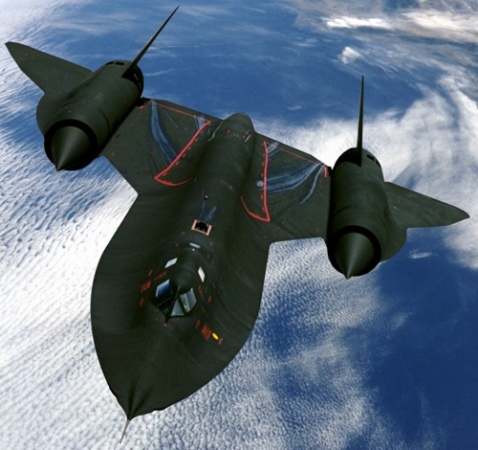 The SR-71 Blackbird is a strategic reconnaissance aircraft developed by Lockheed Skunk Works from the Lockheed A-12 and YF-12A. The Blackbird was a huge improvement over its predecessor the U-2 reconnaissance aircraft. The SR-71 could cruise at 3.5 Mach, which is about 3 times faster than the speed of sound, at an altitude above 100,000 feet and has a range of about 4000 miles. The power plant of SR-71 Blackbird is the two Pratt & amp; Whitney J58-1 continuous-bleed afterburning turbojets, 32,500 lbf (145 kN) each, the fuel for the SR-71 is JP-7 giving the aircraft enough thrust to touch 2,500 mph. It had its ups and downs during the 4 decades of serving in the United States Air Force, after being introduced in 1966 and later retiring from service in the late 80’s. The SR-71 Blackbird was revoked into the USAF in the early 90’s due to its reconnaissance abilities and because no better replacement was available. The aircraft took a second and final retirement in 1998.
 The X-15 was part of the X-series of rocket-powered experimental aircraft development. It was probably the most ambitious effort made to push the limits of flight and explore the prospects of space travel. During this experimental program the X-15 recorded a ground-breaking altitude of 354,330 ft attaining a maximum speed of 4,520 mph (6.72 Mach), the fastest set by any manned aircraft till date. It could be said that X-15 proved to be the test bed for a variety of experiments concerning the space. The X-15 used a Thiokol XLR99-RM-2 liquid-fuel rocket engine to deliver the thrust that it packed; it was fueled by liquid oxygen and ammonia. The aircraft also consumed hydrogen peroxide to drive the high-speed pump that pumped the fuel in to the engine. The aircraft essentially had no landing gear, just a pair of skies and a long run-way as the aircraft skidded to a stop after a 200 mph landing. Much of the data collected during the X15 program proved to be valuable in the space shuttle development.
 The X-43A scram-jet is an unmanned experimental hypersonic aircraft meant to assess capabilities of a hypersonic flight; it was recognized for the worlds fastest flight set by a jet-powered aircraft. The speed clocked by the X-43 scram-jet was beyond comparison to any aircraft ever. On Nov. 16, 2004 it touched 9.8 Mach (7,546 mph), which is more than 3 times faster than the SR-71 Blackbird. The craft was designed to encapsulate a new breed of engine called the supersonic-combustion-ramjet, or the “scramjet”. In this engine the external combustion takes place occurs within the air that is flowing in at supersonic speed. The form design of the X-43 was markedly affected by this; the fore-body of the craft was part of the intake airflow, and the aft section was to function like a nozzle. The X-43 engine was primarily fueled by Hydrogen and unlike other engines the scram-jet does not require oxygen to fuel the engine thus the need to carry oxygen on board, thus considerably reducing the size and weight of the aircraft.
 Editors Note: The inclusion of this has been a source of considerable debate and disappointment. We apologize if this choice doesn’t satisfy your criteria to be on this list.

 ( the x43 a being dropped from a plane).


